Yachtmaster questions and answers
Offshore Theory, written by a superyacht bosun with a commercial Yachtmaster Offshore · 28 October 2026
Practice questions for the Yachtmaster Offshore theory, with the answer worked and explained. Every answer comes from the course, and each one links to the lesson or the reading notes it comes from, to go over it properly.
Try to answer each question before you read the answer. Where you get one wrong, open the link: the lesson has the chart, the drawings and the exercises behind it.
Chartwork · Tidal heights · Tidal streams and course to steer · Lights and shapes · Buoyage · Rules of the road · Meteorology · Safety · The diesel engine
Chartwork
Why must distance always be measured on the latitude scale at the side of the chart, and never on the longitude scale along the top or bottom?
A nautical mile is one minute of latitude, so on the side scale one minute is one mile anywhere on earth. The meridians converge towards the poles, so a minute of longitude is a full mile only at the equator, about three quarters of a mile at 45° and nothing at all at the pole. On a large chart, use the part of the side scale level with the leg you are measuring, because the latitude scale stretches as you go north.
The course from the chart is 204°T, variation is 6°W and the deviation card gives 5°W on that heading. What compass course do you steer, and why must variation be applied before deviation?
Going down from the chart towards the compass, west is added. So 204°T plus 6°W gives 210°M, and 210°M plus 5°W gives 215°C. Variation has to come first because the deviation card is tabulated by magnetic heading, so you need the magnetic heading before you can choose the right row. If you apply a correction the wrong way, the error is twice that correction.
You take a hand bearing compass bearing of a tower of 162°, and the variation is 6°W. What do you draw on the chart, and from which end?
A hand bearing compass held away from the boat's iron is taken to have no deviation, so only variation needs correcting. Going up from the compass to the chart, west comes off, which gives 156°T. You draw the line from the tower, because the tower's position is known and yours is not. It runs along the reciprocal, 156 − 180 = 336, back towards you, and you are somewhere on that line.
Three bearings leave a cocked hat. What does its size tell you?
A big cocked hat proves that something is wrong, because three correct lines cannot leave a hole. A small one proves nothing at all: in the course, three bearings wrong by +0.25°, -3.0° and +3.0° close a hat only 5 metres across, and it sits 499 metres from where the boat actually is. So the size is a warning, never a proof of accuracy, and you work from the corner nearest the danger.
In a running fix, what exactly is carried forward, and what decides whether the result is any good?
You carry the position line itself, not a point. You slide the whole line parallel to itself by the course and distance run, and mark it with two arrowheads, then cross it with a second bearing of the same object. The fix is only good if the bearing has turned enough between the two looks (60° in the course example), because two nearly identical bearings give almost the same line. It is also only as good as the reckoning that carries it, and it is wrong by however far the tidal stream has moved you if the stream is ignored.
You measure a leg on the chart and divide it by the speed shown on the log. When can that give a meaningless answer, and why?
A distance measured on the chart is over the ground, because the seabed does not move. The log measures the water going past the hull, so it gives speed through the water. With no tidal stream the two agree and the sum is exact. With a stream running they measure different things, so dividing one by the other gives a number that means nothing.
An almanac page for a French port says TIMES ARE IN ZONE −0100, yet France is one hour ahead of UT. What does the minus mean?
The heading does not give the zone. It gives the correction that takes the printed local times back to UT, so you take an hour off to get UT. A phone calls the same place UTC+1 because it counts the way there, while the almanac counts the way home. To check the sign, remember that France is east of the UK, so the sun gets there first and their clock is ahead.
Tidal heights
What is chart datum, and why is it set at the Lowest Astronomical Tide?
Chart datum is the level the tide is not expected to fall below, and every sounding and drying height is measured from it. It is put at LAT on purpose. If it were set higher, the chart would promise water that is not always there. If it were set lower, every sounding would read deeper than it needs to, so the chart is cautious about the water underneath you.
What is the difference between a charted sounding and an underlined figure on the chart, and how do you get the depth of water at a spot?
A sounding is measured down from chart datum to the seabed. An underlined figure is a drying height, measured up from datum, so it is ground that stands out of the water for part of the day. On the drying side, a larger number means shallower ground. The depth of water is the sounding plus the height of tide: the sounding belongs to the chart and the height of tide belongs to the day.
A bridge has a charted clearance of 14.0 m, HAT is 9.2 m, today's height of tide is 7.0 m and your air draught is 15.6 m. How much room is there over the masthead, and why does the sum work this way?
Charted bridge clearance is measured down from HAT, which is the least air there will ever be, so you first add HAT to measure it from datum: 14.0 + 9.2. Then you take off today's tide, because rising water lifts the boat towards the bridge, and take off the air draught: − 7.0 − 15.6 = 0.6 m. This is the one sum where more tide means less room, metre for metre.
The charted sounding is 0.5 m, the height of tide is 2.7 m, the boat draws 1.8 m and you want a 0.5 m safety margin. How much water do you have to spare?
The depth of water is sounding plus height of tide: 0.5 + 2.7 = 3.2 m. Taking off the 1.8 m draught leaves 1.4 m under the keel. Keeping back your 0.5 m safety margin leaves 0.9 m to spare. The margin is the one figure you decide yourself, to allow for swell, a chart that is a survey and not a promise, and a barometer that can hold the water down.
You want to cross a channel with a charted drying height of 2.0 m. The boat draws 1.8 m and you want a 1.0 m safety margin. What height of tide do you need?
Build the sum up from the ground: the ground stands 2.0 m above datum, then add the 1.0 m you choose to keep and the 1.8 m draught, giving 4.8 m above chart datum. The answer is a height of tide, not a time or a depth, so it is the figure you go and look up in the tide table and on the tidal curve. Whether you can go on a given day depends on whether that day's tide reaches it, and between what times.
What is the rule of twelfths, when do you use it, and where is it least accurate?
You split the time from one turn of the tide to the next into six equal parts, which are not clock hours. The tide moves 1, 2, 3, 3, 2 and 1 twelfths of the range in those parts, because it moves slowly at the turns and fastest in the middle. It is for places with no printed curve, such as a cove, a bar or an anchorage. Against the real tide it is out by 0.17 m on average and 0.48 m at worst, and it is worst in mid-tide.
At a secondary port whose height differences differ at springs and neaps, how do you find the height difference for the day? Use Eastbourne on Newhaven, with Newhaven HW 6.1 m.
You place the day's standard-port height between that port's mean levels, then take the same proportion of the way between the secondary port's two differences. Newhaven's 6.1 m is 53% of the way from MHWN 5.2 to MHWS 6.9, so Eastbourne's difference, which runs from +0.6 at neaps to +0.8 at springs, comes to +0.7 m. That gives HW 6.8 m at Eastbourne. Time differences are interpolated the same way, but by the standard port's time columns.
Tidal streams and course to steer
A tidal stream is given as 'set' and 'drift'. What does each mean, and why does it matter so much not to read set the way you read a wind direction?
Set is the direction the water is going to. Drift is how far it runs in one hour, so one knot carries you one mile. A wind is named for where it comes from but a stream for where it goes, so the two conventions are opposite. Mix them up and you lay the stream off the wrong way round, which puts you twice as far wrong as not applying it at all.
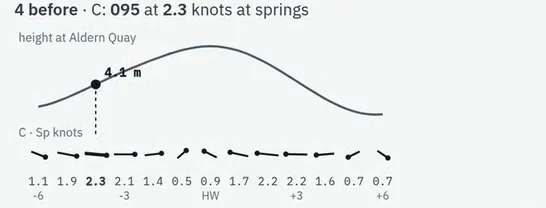
At 1230 on 1 May, high water at Aldern Quay is 0937 (6.8 m) and the next low water is 1522 (2.0 m). Diamond C, row 3 after, reads 271 · 2.2 · 1.4. What stream do you use, and how do you get the rate?
The range must be that of the tide you are working in. After a high water you use the low water that follows it, so 6.8 − 2.0 gives 4.8 m. That is 27 % of the way from 4.2 m at mean neaps to 6.4 m at mean springs, and the rate moves from the neaps figure towards the springs figure by the same proportion. Going from 1.4 knots at neaps towards 2.2 at springs, the stream is 271 at 1.6 knots.
You run a 30-minute DR leg from a fix at 1449 to a DR at 1519, and the atlas gives 277 at 1.5 knots. To plot the EP, which hour's stream do you use, where do you lay it, and how much of it?
You take the stream for the middle of the leg, 1504, because the stream changes during the leg and the middle stands for the whole of it. You lay it from the far end of the reckoning, the 1519 DR, not from the fix, because the fix has been getting older ever since it was taken. You lay only the time you actually ran: half an hour at 1.5 knots is 0.75 M. A whole hour of drift on a half-hour leg puts you as far out as doing nothing, only on the other side.
When working up an EP, is leeway applied to the course or to the distance run, and in what order do leeway and tidal stream go?
Leeway is applied to the course, and the distance stays as the log measured it: the wind does not change how many miles you sailed, only the direction they were sailed in. The order is heading, then leeway to give the water track, then tidal stream to give the EP. The order follows from what happens physically: leeway is the hull crabbing through the water, and the stream then moves that whole body of water, boat and all.
Describe the one-hour triangle for a course to steer. Why is the tidal stream laid from the start, when for an EP it goes on the end?
From where you are, lay the desired track as a line with no length, and from the same point lay one hour of stream. From the end of the stream, open the dividers to one hour of your speed through the water and cut the track. The line from the end of the stream to the cut is the water track, and its direction is the course to steer. For an EP the stream goes on the end because it corrects something already sailed; here it goes on the start because it corrects nothing but asks where you must point.
Your triangle gives a water track of 084°T. The wind is from 340 and you make 10° of leeway. What heading do you steer, and what is the classic mistake?
When you are steering, the bow goes to windward of the water track by the amount of leeway, because you are allowing in advance for what the wind is going to do. The wind from 340 pushes her towards 160, to starboard, so you point 10° to port: steer 074, crab 10° downwind and make good 084. The classic mistake is to put the leeway to leeward as you would for an EP. That gives 094, and steering 094 she makes good 104, which is 20° off.
Lights and shapes
When must a vessel show her navigation lights, and what does the second part of the rule mean for a passage in fog by day?
Rule 20 requires them from sunset to sunrise in all weathers, and also by day in restricted visibility. People tend to miss the second part: in fog at noon every vessel around you has her navigation lights on and her day shapes up as well. The same conditions also switch on her fog signal, so a ship sounding one prolonged blast at midday is obeying Rule 35(a), not making a mistake.
Give the arcs of the sidelights, masthead light and sternlight, and explain where the cut between them falls.
Each sidelight covers 112.5°, from right ahead to 22.5° abaft its own beam, so together they make 225°, which is exactly the arc of the masthead light. The sternlight covers the remaining 135°, so the whole horizon is covered once with nothing doubled. The cut therefore falls 22.5° abaft the beam, not on it: a vessel 100° off your bow can still see your masthead light, and one at 115° cannot.
One power-driven vessel shows one masthead light and another shows two. What can you say about their lengths?
One masthead light proves she is under 50 m, because a vessel of 50 m or more must carry two. Two masthead lights prove nothing, because Rule 23(a)(ii) lets a vessel under 50 m show the second light if she chooses. So the count only tells you something in one direction.
At night you see a tug with three masthead lights in a vertical line. What does it tell you, and what must you not do?
Towing lights are carried in a vertical line, not stepped like ordinary masthead lights, and the number in the line gives the length of the tow: two for 200 m or less, three for more. The tow is measured from the stern of the tug to the after end of the tow, so a 60 m barge on 150 m of wire is a 210 m tow and shows three. The wire runs just under the water, so never cross between a tug and her tow, and that includes crossing astern of the tug, where it looks like clear water.
You see a green light and a white light together. How can you tell a ship showing her starboard side from a trawler without judging which light is higher?
On the ship the green is a sidelight, which cuts off at 112.5° from her bow. On the trawler it is an all-round green over an all-round white. Seen from her quarter, the ship would show only a sternlight, but the trawler's green would still be lit. Judging the height of two small lights at night is exactly what goes wrong, whereas a green that is still there after you cross the cut cannot be a sidelight.
In fog you hear a power-driven vessel sound two prolonged blasts instead of one. What is the difference?
Both mean a power-driven vessel under way, but two prolonged blasts means she has stopped, while one means she is making way: both are under way, and only one of them is moving. At night her lights could never tell you this, because a power-driven vessel shows the same lights stopped or moving (Rule 23(a)). In fog you get it anyway: one blast or two.
Buoyage
What does a north cardinal mark tell you to do?
It does not mean steer north. It means the clear water is to the north of it: the mark is named after the water, not after your course. If you are already north of it you are in clear water, so which side to pass depends on where you are, not on anything you can memorise about the mark.
Two boats pass the same red can, each leaving it on a different side, and both are right. How can that be?
A lateral mark marks one edge of a channel, and which edge depends on the direction of buoyage. The buoy does not change; what changes is the direction each boat is going. That is why remembering a side on its own is not enough: you need the direction of buoyage, which is printed on the chart, not guessed.
What do a safe water mark and a special mark each tell you, and why does neither tell you to pass on a particular side?
A safe water mark means there is navigable water all round it, so either side will do; in Stennick Haven it marks the seaward entrance to the channel. A special mark does not tell you where safe water is at all: it marks an area or a feature, such as a cable, a pipeline, an outfall or a firing range, and the chart says which. Knowing that a mark is not telling you what to do is as useful as reading the marks that are.
How do you tell the four cardinal marks apart at night, and why does the south cardinal have a long flash?
All four show quick-flashing white lights, so you count the flashes, which follow a clock face. East shows three, south six and west nine, and north, which has no number on the clock, flashes without stopping. The south cardinal adds a long flash after its six so that six flashes counted in a seaway cannot be mistaken for three or nine.
At night, how do you tell a safe water mark from an isolated danger mark, and why does it matter?
Both show white lights, so only the rhythm separates them. Safe water gives one long flash of two seconds or more, while an isolated danger mark gives two short flashes, never more. Confusing them means taking a danger for open water, which the notes call the worst mistake in the module.
In a light's characteristic printed on the chart, what do the number in brackets and the period mean, and how would you check the period?
The number in brackets is how many flashes there are in one group: it is a count, not seconds and not a range. The period is how long one whole cycle takes, from the start of one group to the start of the next, including the darkness. You can time it yourself by starting a watch on the first flash of one group and stopping it on the first flash of the next. If no colour is printed, the light is white.
Rules of the road
When is a meeting a head-on situation under Rule 14, what must each vessel do, and what if you are unsure?
Rule 14 covers two power-driven vessels meeting on reciprocal or nearly reciprocal courses with risk of collision, and each alters to starboard so that they pass port to port. It applies when you see the other vessel ahead or nearly ahead with her masthead lights in line or nearly in line, or both sidelights, or both. If you are in any doubt you must assume it is head-on. If her masthead lights are plainly open and only one sidelight shows, you are off her centreline and Rule 14 does not settle the situation.
Two power-driven vessels are crossing on a steady bearing, and the other vessel is on your starboard side. What do you do, and why not turn to port?
She is on your starboard side, so under Rule 15 you keep out of the way and, if the circumstances allow, avoid crossing ahead of her. That means altering to starboard and passing under her stern, and making the alteration large enough to be readily apparent, as Rule 8 requires. A turn to port can take you across her bow, which is exactly what the second half of Rule 15 rules out, and it takes you towards the water she is about to be in.
What does Rule 16 ask of a give-way vessel, and why is an early but small alteration not enough?
It asks for early and substantial action to keep well clear, and it needs both. In the worked encounter, altering 45° to starboard with 30 minutes to go passed 2.96 M off, whereas the same helm at the same moment but only 10° of alteration would have left 0.65 M. Keeping well clear means the stand-on vessel never has to think about avoiding you, not merely that you miss her.
You are the stand-on vessel in a crossing, and the give-way vessel on your port side is doing nothing. What does Rule 17 allow and require, and why not turn to port?
At first you must keep your course and speed, because she is planning her manoeuvre on the assumption that you will hold them. You may act on your own once it becomes apparent that she is not taking appropriate action, and you must act once collision cannot be avoided by her action alone. Rule 17(c) says not to alter to port for a vessel on your own port side, because when she finally does what the Rules require, she will alter to starboard, straight into the water you have turned towards.
Under Rule 18, does a power-driven yacht have to keep out of the way of a vessel constrained by her draught?
No. A vessel constrained by her draught is not in Rule 18's order of who keeps out of whose way. Instead, every vessel other than one not under command or one restricted in her ability to manoeuvre must avoid impeding her safe passage, a duty that starts much earlier than keeping out of the way. The vessel constrained by her draught must in turn navigate with particular caution, and nothing in the Rules gives anybody right of way.
In fog you detect a vessel by radar alone, forward of your beam, with risk of collision. Who stands on, and which alterations should you avoid?
Nobody stands on. Rule 19 applies to vessels not in sight of one another, so the stand-on and give-way rules and the Rule 18 order do not apply, and every vessel must take action. So far as possible, avoid altering to port for a vessel forward of the beam unless you are overtaking her, and avoid altering towards a vessel abeam or abaft the beam. Your avoiding action may be to slow down, and if you hear her fog signal apparently forward of the beam, you reduce to the minimum speed at which you can keep your course.
Meteorology
Over the open sea, how does the surface wind differ from the wind suggested by the isobars, and why?
Away from the surface, the pressure gradient and the turning of the Earth balance out, so the wind blows along the isobars. Near the surface, friction slows the wind and turns it across the isobars towards the low. As a rule of thumb, over the sea it is turned about 10–15° and is roughly two-thirds of the strength the isobar spacing suggests. Over land it is turned much more and is weaker still.
A depression is moving east past you. How will the wind change if its centre passes north of you, and how if it passes south of you?
If the centre passes north of you, you cross the warm and cold fronts and the wind veers as they go by. If it passes south of you, you never cross the fronts and stay in the cold air north of the centre, so the wind backs. This follows from Buys Ballot's law: with your back to the wind the low is on your left, so a low passing south of you from west to east turns the wind anticlockwise.
Why can high cloud such as cirrostratus warn you of a warm front long before it arrives?
At a warm front, warm air rides up over cold air on a gentle slope of about 1 in 150, so its high cloud arrives well ahead of the surface front. The leading edge is about 800 km ahead. Cirrostratus spreading as an even veil means the warm front will probably bring persistent rain within a day. As the front gets closer the cloud lowers and thickens through altostratus to nimbostratus, and the barometer falls.
How does sea fog form, and why is it more of a problem at sea than radiation fog?
Sea fog is advection fog. It forms when relatively warm, moist air moves over a cooler sea and contact with the sea cools it to saturation. The sun does little to clear it, because the sea stays at much the same temperature by day and by night, so it usually lasts until a change of wind carries it over warmer water or land. Radiation fog, by contrast, usually clears soon after sunrise as the sun warms the ground.
Your hourly log shows the barometer has fallen 4 hPa in the last three hours. What word would the forecast use for that tendency, and what does it tell you?
A fall of 3.6 to 6.0 hPa in three hours is 'falling quickly'. You get the tendency by taking away the reading from three hours before, which is why the reading goes in the log every hour. A quick fall means something is approaching or deepening fast, such as a depression or its front, so you should watch the forecast and the sky more closely.
When is a gale warning issued, how long does it remain valid, and how do you read its timing words?
A gale warning is issued for winds of force 8 (34 knots) or more, or for gusts reaching 43 knots or more, so either the mean wind or the gusts can trigger it. It is issued as required, as soon as possible after it is received, and is valid for 24 hours unless cancelled. Its timing words (imminent, soon, later) are counted from the time of issue, not from when you hear them.
Safety
What is the essential difference between a lifejacket and a buoyancy aid?
A lifejacket keeps you face up without you doing anything. It turns most people until their mouth is out of the water, even when they are exhausted, and it is designed to turn an unconscious person face up. A buoyancy aid only holds you up, with no real ability to turn you, and you may have to move to get your face out of the water. That is why the difference matters most if you go in and cannot help yourself.
You have pressed and held the DSC distress button. When do you start your spoken Mayday, and on which channel?
The button sends the alert as data on channel 70, with your MMSI and position, without you saying a word. You then speak on channel 16, the distress and safety channel for voice. Start once the acknowledgement comes back, or after about fifteen seconds if it does not. If the GPS lead has failed, the alert still goes but without your position, so you give the position in the spoken message.
Your engine has died and a swell is setting you towards a rocky coast that is still some way off, while you try to get sail up. Mayday or Pan-Pan?
Pan-Pan. A Mayday is for a vessel or person threatened by grave and imminent danger who needs immediate assistance. A Pan-Pan announces a very urgent message about the safety of a vessel or a person. Here the danger is real but not yet imminent. If the shore gets close enough that going ashore is imminent, it becomes a Mayday, and distress takes priority over your earlier urgency call.
What happens to your body in the first minute after falling into cold water, and what should you do about it?
The sudden chilling of the skin causes a gasp you cannot stop, and your breathing can run out of control at up to ten times its normal rate. About half a pint of seawater in the lungs is enough to start drowning a grown man, so the danger is not the cold but being unable to breathe. The RNLI's Float to Live advice is not to swim straight away: tip your head back, relax, get your breathing under control and move your hands and legs gently. The effects pass in less than a minute.
Why must you shut off the gas supply before dealing with a gas fire, rather than just putting the flame out with dry powder?
Dry powder will knock a gas flame down, but if the gas is still running, unburnt gas keeps filling the boat. That build-up is worse than the fire, so you cut the supply first by closing the bottle. For the same reason, gas is turned off at the bottle whenever it is not in use, and you never look for a leak with a flame.
When a helicopter lowers a weighted line to your boat, why must it never be made fast, and why do you let it touch the deck or the water before handling it?
A weak link joins the weighted line to the winch hook. It is there to break, so the helicopter is never tied to a boat that is rising and falling with the sea. So the line is never made fast, not even a turn on a cleat, and you only ever haul on it when the crew tell you to. The line can carry a static charge, so you let it earth on the deck or in the water before anyone touches it.
The diesel engine
The engine will not start and you have been cranking for a while. Why should you stop, and what must you do before cranking again?
The engine drives the raw-water pump, so every turn of the starter pumps seawater into the exhaust even though the engine has not fired. With no exhaust gas to blow it out, the water fills the waterlock and backs up to the mixing elbow and an open exhaust valve. Water does not compress, so a piston coming up against a cylinder full of it bends or breaks something. Close the seacock or remove the impeller first, and tie a note to the key, because an impeller run dry is finished in seconds.
Why will a diesel not start after a fuel filter change, and in what order do you bleed the fuel system?
Any time you open the fuel system, you put air in it. With air in the circuit the pump squashes a bubble instead of pushing, so the injection pump cannot build pressure and she will not start. You bleed it with the priming lever on the lift pump, opening each bleed screw until clean diesel comes out with no bubbles, in the order of the circuit: from the tank towards the injectors. Going backwards would push the air you have just chased back where it came from.
Your engine is overheating. Which single check splits the likely causes in two, and what does each result point to?
Look for water coming out of the exhaust. If there is none, the fault is in the open raw-water circuit: check the seacock, then the strainer, then the impeller. If water is coming out, the seacock, strainer, impeller and belt are all working, so the fault is in the sealed fresh-water circuit: the coolant level, the thermostat or a furred-up heat exchanger.
The engine keeps making black smoke while it is under load. What does this mean, and where do you look first?
Black smoke is fuel that has not burned properly. Either there is too much fuel for the air available, or the fuel is arriving badly. Check the air filter first, because it is the cheapest item on the list, the commonest cause and takes a minute to check. Then check the turbocharger, and only then the injectors, which are workshop work. A puff when you open the throttle hard is normal on an older engine, but black smoke that stays while she works is not.
How do you stop a marine diesel, and why must you never stop it with the battery isolator?
A diesel has no spark and lights its own fuel by compression, so cutting the electricity does not stop it. You stop it by cutting the fuel: the stop control pulls a cable to the governor on the injection pump, which stops delivering. Turning the isolator off while the engine is running does not stop it, and it can destroy the alternator, which is still charging into a circuit you have just disconnected. Stop the engine first, then isolate.
Under way, the charging warning light comes on at the same time as the temperature gauge starts to rise. What is the most likely cause, and why?
One belt drives the alternator, the fresh-water pump and the seawater pump off one pulley, and when it goes all three stop. So you lose charging and the engine's cooling at the same time. That is why a charge light and a rising temperature together mean a broken belt until proved otherwise, and it is the one fault you can diagnose from the helm before you open anything.
More practice
The course ends with a mock of the theory exam: random questions from every subject, then a complete passage plan, with pass or fail at the end and what to work on next. For what the theory covers and how to approach it, read the guide to the theory exam.