The cocked hat and crossing bearings
Offshore Theory, written by a superyacht bosun with a commercial Yachtmaster Offshore · 30 October 2026
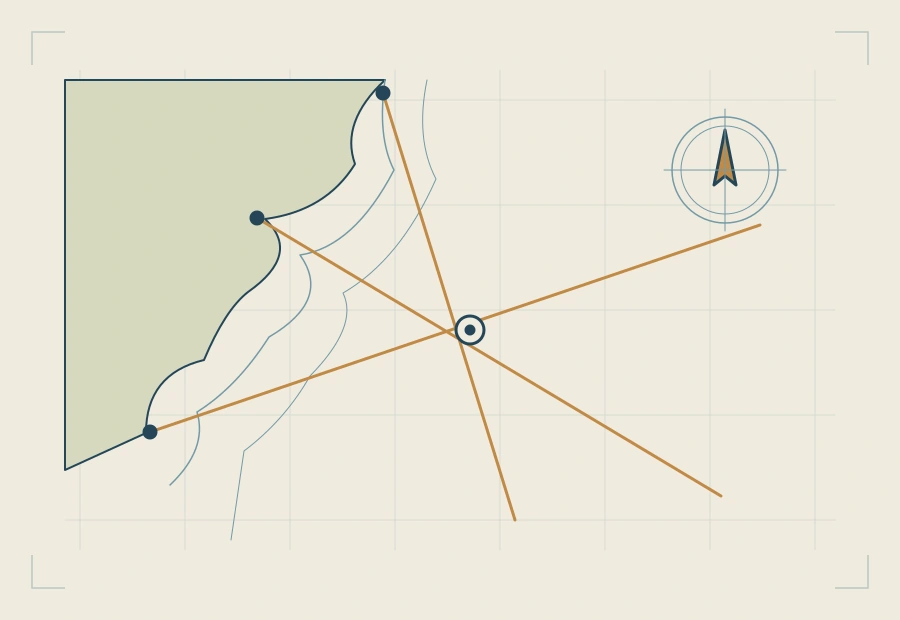
A fix from crossing bearings is the workhorse of coastal navigation: point a compass at two or three charted objects, draw the lines back from them, and you are where they cross. Getting a good one depends on choices you make before you look through the compass.
Choosing the marks
- Charted and identified. A lighthouse, a church tower, the end of a breakwater, a conspicuous building. If you are not sure it is the one on the chart, it is not a mark.
- Well spread. Two bearings as near 90° apart as you can, three bearings about 60° apart. A shallow angle of cut turns a one-degree error into a long smear along the lines.
- Near rather than far. An angular error moves the line sideways by the distance times that angle. One degree is about 32 metres at a mile, and 160 metres at five.
The order you take them in
The boat moves while you take the bearings, so the bearings change while you are taking them. Objects near the bow or the stern change bearing slowly; the one nearest the beam changes fastest. Take the slow ones first and the fast one last, and note the time at the last one: that is the time of the fix.
A worked example
Heading 080°T, you take three bearings with the hand-bearing compass, in this order: a headland light at 052°M (30° on the port bow), a tower at 112°M (30° on the starboard bow), and a church spire at 352°M (on the port beam), at 1415. Variation is 2°W.
- Convert to true: magnetic to true with westerly variation, subtract. 052°M → 050°T, 112°M → 110°T, 352°M → 350°T.
- Check the cut: 050° and 110° are 60° apart, 110° and 350° meet at 60°, and 350° and 050° are 60° apart. As good as three bearings get.
- Plot: from each object, draw the line back towards you along the reciprocal: the headland light's line runs from the light on 230°, the tower's on 290°, the spire's on 170°.
Reading the cocked hat
Three lines almost never meet in a point. They leave a small triangle, the cocked hat, and its size is the honest measure of the fix.
- Small: the fix is good. Mark your position at the corner nearest to danger, not in the middle, and give that danger the room it deserves.
- Large: do not pick a point inside it. One of the lines is wrong. Check that each object is the one on the chart, that each reading was written correctly, that each was converted the same way, and that the bearings were not taken too far apart in time. Then take them again.
One warning about a small hat: if every bearing carries the same error (the wrong variation, a compass with deviation you have not allowed for), the three lines can still meet neatly, in the wrong place. A small cocked hat says the bearings agree, not that they are right. Check the fix against the depth under you and the dead reckoning.
How big an error is
A bearing that is 5° out on an object 3 miles away moves its line sideways by about 3 × 1,852 m × tan 5° = 490 metres, a quarter of a mile. That is the size of error a bit of heel, a lump of iron near the compass or a hurried sight can produce.
And the best line of all
Two charted objects in line, a transit, give a position line with no compass in it at all. If you can get one, use it as one of your lines.
Where this is in the course
Getting a fix: crossing bearings and the cocked hat →
Position lines: bearings, transits and soundings →
Free reading notes: crossing bearings and the cocked hat →
Free reading notes: position lines, bearings and transits →
Questions
Why take three bearings instead of two?
Two lines always cross, so a mistake in either one goes unnoticed. A third line checks the other two: if all three meet in a small triangle, the fix is probably good; if they do not, something is wrong.
What is the best angle between bearings?
For two bearings, as near 90 degrees as you can get. For three, about 60 degrees apart. Lines that cross at a shallow angle turn a small error into a long, uncertain crossing.
In what order should I take the bearings?
Objects near the bow or stern first, because their bearings change slowly; the object nearest the beam last, because its bearing changes fastest. Then write the time against the fix.
Where am I in a cocked hat?
If the triangle is small, take the corner nearest to danger as your position and keep clear accordingly. If it is large, do not choose: recheck what you identified, the readings, the conversion to true and the timing, and take the bearings again.
Do I apply deviation to a hand-bearing compass?
Its deviation depends on where you stand, and you take it from clear of steel and electronics so that it is small. Convert the bearings from magnetic to true with the variation, and treat any remaining error as part of the cocked hat.
Related guides
- Set, drift and the estimated positionFrom the dead reckoning to the EP: the stream for the time run, leeway, and the triangle drawn the right way.
- Dead reckoning vs estimated positionWhat a DR leaves out, what an EP adds, and how each is marked and trusted on the chart.
- The running fixOne mark, two bearings and the run between them: how to transfer the line, with and without a stream.
- True, magnetic and compass: variation and deviationUpdating variation, reading the deviation card and converting both ways without getting the sign wrong.