The running fix
Offshore Theory, written by a superyacht bosun with a commercial Yachtmaster Offshore · 30 October 2026
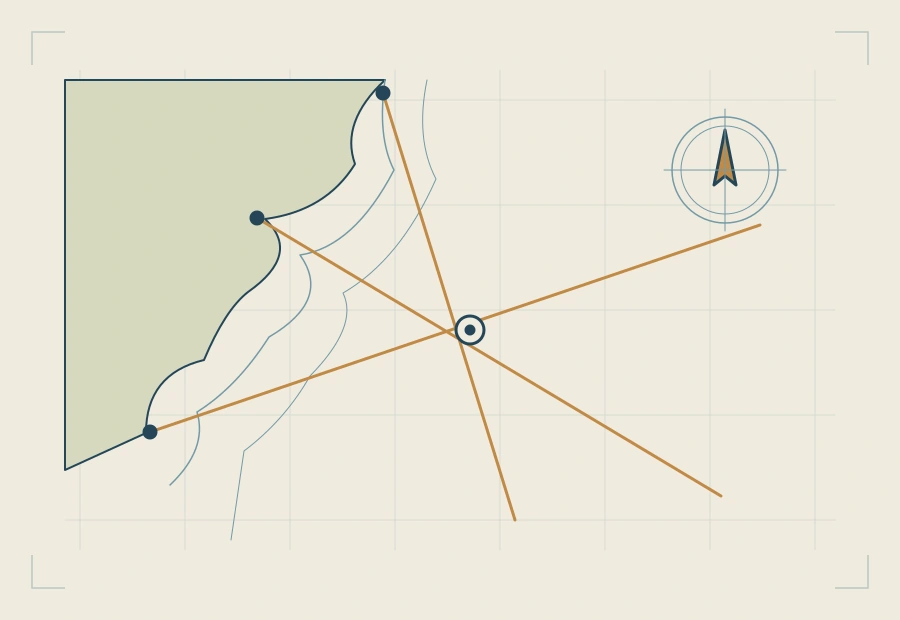
A fix needs at least two position lines at the same moment. When there is only one thing in sight, a lighthouse on a long featureless coast, you can still get one: take its bearing, sail on, take it again, and carry the first line forward by the distance you have travelled. That is a running fix.
The method
- First bearing. Note the time and the log reading, and draw the position line from the object.
- Run on. Keep a steady course. Wait until the bearing has changed by a useful angle.
- Second bearing. Note the time and log, and draw the second line.
- Work out the run. From any point on the first line, lay off the water track for the distance on the log, then the stream for the same time. That gives the boat's movement over the ground.
- Transfer the first line. Move it, parallel to itself, by that movement. Mark it with double arrowheads at each end so it is clearly a transferred line.
- The fix is where the transferred line crosses the second line, at the time of the second bearing.
Worked example 1: no stream
Steering 090°T at 6.0 knots, with no stream. At 1400 (log 12.4) a lighthouse bears 045°T. At 1430 (log 15.4) it bears 000°T. (Round figures for the guide.)
The run is 3.0 miles on 090°. Move the 1400 line 3.0 miles east, parallel to itself. It crosses the 1430 line exactly 3.0 miles due south of the lighthouse: that is the fix at 1430.
This is also the four-point bearing: the light was 45° on the bow at the first bearing and abeam at the second, so the distance off when abeam equals the distance run. It only holds with no stream and no leeway.
Worked example 2: with a stream
Same course and speed, but now a stream sets 180°T at 1.0 knot. At 1400 the lighthouse bears 050°T; at 1430 it bears 000°T.
- The run through the water: 3.0 miles on 090°.
- The stream for half an hour: 0.5 miles on 180°.
- Transfer the 1400 line by both: 3.0 miles east and 0.5 miles south.
The transferred line crosses the 1430 bearing 3.0 miles south of the light. If you had moved it only by the log run and forgotten the stream, it would have crossed at 2.5 miles: a fix half a mile out, the stream's drift for that half hour. Here the error puts you closer to the light than you are; on another day it puts you further from the rocks than you are.
How much to trust it
A running fix is only as good as the run between the bearings: the steering, the log, the leeway and above all the stream. It is better than an EP because it uses a real observation, and worse than a fix from two objects at once. Mark it as a running fix, with both times, so you remember what it is worth.
The same transfer works with any position line, not only bearings: a transit, a depth contour, or a line from a radar range.
The common slips
- Moving the line by the log alone when there is a stream.
- Moving the object instead of the line. The lighthouse stays where it is; the first line moves.
- Too small a change of bearing. Two nearly parallel lines give a fix that slides along them.
- An alteration of course between the bearings without adding each leg of the run separately.
Where this is in the course
Dead reckoning and running a position line on →
Free reading notes: dead reckoning and the running fix →
Fixing your position by radar →
Questions
When do I need a running fix?
When only one charted object is in sight. You take its bearing, run on for a while, take its bearing again, and carry the first line forward to cross the second.
How far do I move the first position line?
By the boat's movement over the ground between the two bearings: the water track for the distance on the log, plus the tidal stream for the same time. Move the whole line, parallel to itself.
What if I ignore the stream?
The fix is wrong by the stream's drift, in its direction. Half an hour of a one-knot stream is half a mile.
How long should I wait between the two bearings?
Long enough for the bearing to change by a good angle, ideally 30 degrees or more, but not so long that errors in the run build up. A change of 45 to 90 degrees is a good aim.
What is the four-point bearing?
A special case: if the object is 45 degrees on the bow at the first bearing and abeam at the second, with no stream and no leeway, the distance run between them equals the distance off when abeam.
Related guides
- Set, drift and the estimated positionFrom the dead reckoning to the EP: the stream for the time run, leeway, and the triangle drawn the right way.
- Dead reckoning vs estimated positionWhat a DR leaves out, what an EP adds, and how each is marked and trusted on the chart.
- The cocked hat and crossing bearingsChoosing marks, the angle of cut, the order you take them in, and what the cocked hat tells you.
- True, magnetic and compass: variation and deviationUpdating variation, reading the deviation card and converting both ways without getting the sign wrong.