Course to steer and the tidal triangle
Offshore Theory, written by a superyacht bosun with a commercial Yachtmaster Offshore · 30 October 2026
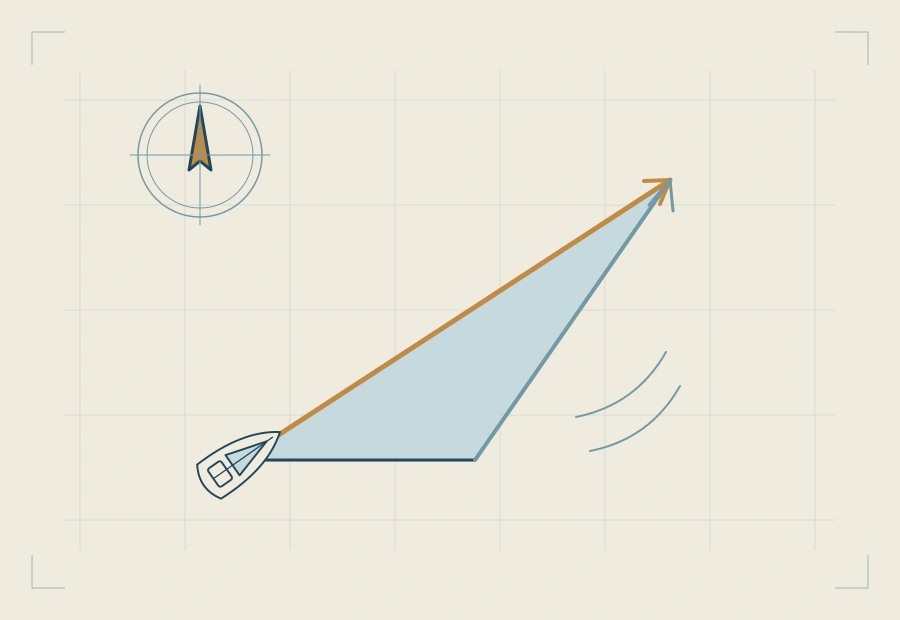
A course to steer answers one question: which way do I point the boat so that the stream and the wind deliver me where I want to go? The tool is a triangle of vectors drawn for one hour, and once you have drawn it a few times it takes two minutes.
The three sides
- The ground track (two arrowheads): the line from where you are to where you want to be. You want to make it good.
- The tidal stream (three arrowheads): set and rate for the hour, from a diamond or the atlas.
- The water track (one arrowhead): the boat's course and speed through the water. Its direction is what you are looking for.
The worked example
You are at A and want to reach B, 10.0 miles away on a track of 090°T. The boat makes 6.0 knots through the water. For the next hour the stream sets 180°T at 2.0 knots. (Round figures for the guide, so that each step can be checked.)
Drawing it
- 1. Draw the track. A line from A through B, and on past B: the triangle may end beyond it.
- 2. Lay off one hour of stream from A. 2.0 miles in the direction 180°. Call the end C.
- 3. Swing one hour of boat speed from C. Open the dividers to 6.0 miles on the latitude scale, put one point on C, and mark where the other cuts the track line. Call it D.
- 4. Measure C to D. That direction is the water track, the course to steer before leeway. A to D is the distance made good over the ground in that hour, so it is the speed over the ground.
The answer
C is 2.0 miles due south of A. D is on the track due east of A, and 6.0 miles from C, so it is √(6.0² − 2.0²) = √32 = 5.66 miles from A.
- Course to steer: 071°T. The line C to D runs 5.66 miles east for 2.0 miles north, which is 70.5° from north.
- Speed over the ground: 5.7 knots, the length of A to D.
- Time to B: 10.0 ÷ 5.66 = 1.77 hours, about 1 hour 46 minutes.
Notice that you point 19° to the left of the track, into the stream, and lose a little speed over the ground, but you never leave the line.
Adding leeway
The wind is from the south-east, on the starboard bow, and the boat makes about 5° of leeway: she slides 5° downwind of where she points, to port. To make good the water track of 071°, steer 5° towards the wind: 076°T.
The rule is always the same for a course to steer: apply leeway into the wind. (For an estimated position you do the opposite: the boat ends up downwind of her heading.)
Down to the compass
Variation here is 2°W: 076°T becomes 078°M. The deviation card gives 3°E for that heading: 078°M becomes 075°C. That is the figure for the helmsman.
Longer passages
For a leg of more than an hour, do not draw a new triangle each hour. Lay off each hour's stream end to end from A (two hours of stream for a two-hour leg, with each hour's own set and rate), then swing two hours of boat speed from the end of the last one. The result is one course to steer for the whole leg; the boat wanders either side of the track as the stream changes, and arrives where you planned.
The common slips
- Drawing the stream from the wrong end. For a course to steer, the stream goes from the start point; the boat's speed is swung from the end of the stream.
- Reading the course off A to D. That is the ground track, which you already knew. The course is C to D.
- Mixing hours. One hour of stream with one hour of boat speed, or two with two.
- Applying leeway downwind. For a course to steer it goes into the wind.
Where this is in the course
Course to steer: the one hour vector triangle →
Leeway: how much, which side, and where it goes →
Free reading notes: course to steer →
Questions
What is the difference between course to steer and track?
The track is the line you want to make good over the ground. The course to steer is the heading through the water that, with the stream pushing you, keeps you on that track.
Why does the triangle use one hour?
Because the stream and the boat speed are both in knots, one hour of each is a distance you can lay off with the dividers. For a passage of two or three hours you lay off two or three hours of stream and the matching distance of boat speed.
Which way do I apply leeway for a course to steer?
Into the wind. The wind will push the boat downwind of the heading, so you steer that many degrees towards the wind to make good the water track you worked out.
What if the stream is stronger than the boat?
If the cross-track part of the stream is more than the boat's speed, the arc of the boat's speed never reaches the track line: there is no course that holds it. You wait for the stream to ease or change the plan.
Do I need a new course to steer every hour?
Not if you work the whole passage in one triangle with the stream for each hour added together. That gives one course to steer for the whole leg, which is what you want at the helm.
Related guides
- Tidal diamonds and the tidal stream atlasSet and rate for the hour from a diamond or the atlas, and interpolating between springs and neaps.
- Set, drift and the estimated positionFrom the dead reckoning to the EP: the stream for the time run, leeway, and the triangle drawn the right way.
- Dead reckoning vs estimated positionWhat a DR leaves out, what an EP adds, and how each is marked and trusted on the chart.
- True, magnetic and compass: variation and deviationUpdating variation, reading the deviation card and converting both ways without getting the sign wrong.