IALA buoyage region A, by day and by night
Offshore Theory, written by a superyacht bosun with a commercial Yachtmaster Offshore · 30 October 2026
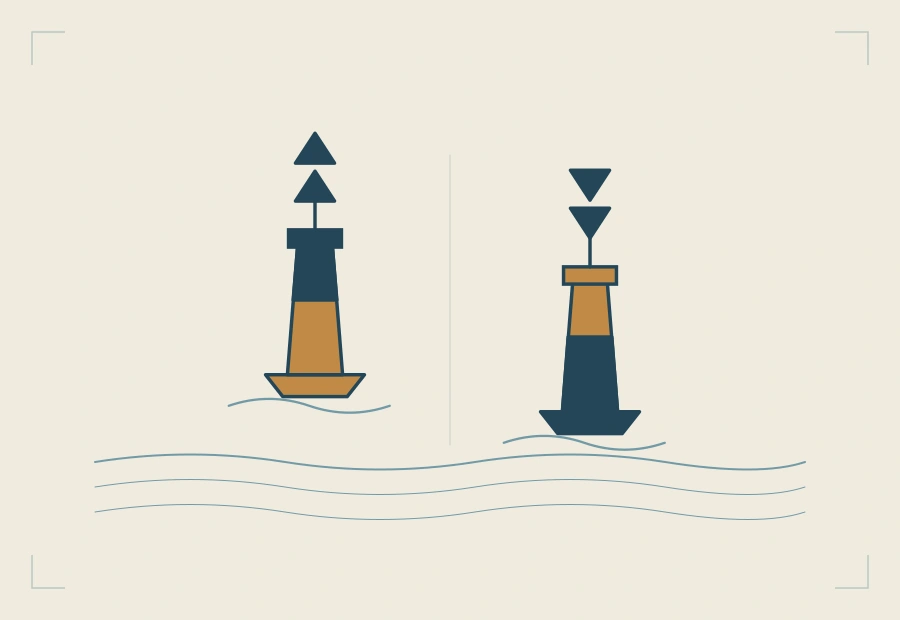
The IALA system gives every buoy and beacon a meaning you can read from its shape, its colour and its topmark by day, and from the colour and rhythm of its light by night. Region A, used around Europe, Africa, Australia and most of Asia, has six kinds of mark. This page goes through each one.
Lateral marks: the sides of the channel
Lateral marks show the sides of a channel in the direction of buoyage: generally from seaward into a harbour, river or estuary. Elsewhere the chart shows the direction with a symbol.
| Mark | Colour and shape | Topmark | Light | Leave it |
|---|---|---|---|---|
| Port hand | Red; can (cylinder), pillar or spar | Red can | Red, any rhythm except (2+1) | To port |
| Starboard hand | Green; cone, pillar or spar | Green cone, point up | Green, any rhythm except (2+1) | To starboard |
Where a channel divides, a preferred channel mark shows which branch is the main one:
| Mark | Looks like | Light | Preferred channel |
|---|---|---|---|
| Preferred channel to starboard | Red with one broad green band; can | Red Fl(2+1) | To starboard: treat it as a port-hand mark to stay in the main channel |
| Preferred channel to port | Green with one broad red band; cone | Green Fl(2+1) | To port: treat it as a starboard-hand mark |
Region B uses the same shapes with the colours swapped: red to starboard, green to port, entering from seaward.
Cardinal marks: where the safe water is
A cardinal mark is placed in one of the four quadrants of a danger and is named after that quadrant: a north cardinal is north of the danger, and the safe water is to its north. All are black and yellow, with two black cones as a topmark and a white light.
| Mark | Topmark | Colours | Light |
|---|---|---|---|
| North | Both cones point up | Black over yellow | VQ or Q, continuous |
| East | Points apart | Black, yellow, black | VQ(3) every 5 s or Q(3) every 10 s |
| South | Both point down | Yellow over black | VQ(6) + LFl every 10 s or Q(6) + LFl every 15 s |
| West | Points together | Yellow, black, yellow | VQ(9) every 10 s or Q(9) every 15 s |
Two ways to remember them. The cones point to where the black is: both up, black on top; both down, black at the bottom. And the lights follow a clock face: 3 o'clock east, 6 south, 9 west, and north continuous. The long flash after the south's six makes it impossible to confuse with a nine or a three.
Isolated danger
Placed on a danger of limited size with navigable water all round it: a rock or a wreck in open water. Black with one or more broad red bands, topmark two black balls, light white Fl(2). Do not pass close.
Safe water
Navigable water all round: a landfall buoy off a harbour, or the middle of a channel. Red and white vertical stripes, spherical, pillar or spar; topmark one red ball; light white, isophase, occulting, one long flash every 10 seconds, or Morse "A".
Special marks
Not mainly for navigation: they mark an area or feature, such as a spoil ground, a cable, a racing mark or a data buoy, explained on the chart. Yellow, any shape that does not conflict with a navigation mark; topmark a yellow X; light yellow, with a rhythm not used for white lights.
Emergency wreck marking buoy
For a new wreck, before it is charted. Blue and yellow vertical stripes; topmark an upright yellow cross; light alternating blue and yellow flashes. Treat it with the same caution as the danger it marks; it may later be replaced by ordinary cardinal or lateral marks.
Reading a light on the chart
- Fl: flashing, light shorter than dark. LFl: a long flash of at least 2 seconds.
- Q: quick, 50 or 60 flashes a minute. VQ: very quick, 100 or 120 a minute.
- Iso: equal light and dark. Oc: occulting, light longer than dark.
- Groups in brackets: Fl(2) is two flashes then a pause; the period after it, such as 10s, is the time for the whole cycle.
Where this is in the course
The buoyage module is free, with no account: the marks, which side to pass them, and how to read them at night.
Buoyage, part 1: the marks (free) →
Buoyage, part 3: at night (free) →
Free reading notes: which side to pass a buoy →
Free reading notes: buoy lights at night →
Questions
Which side do I leave a red buoy in region A?
Going in the direction of buoyage, generally from seaward into a harbour, red port-hand marks are left to port and green starboard-hand marks to starboard.
Where is region A?
Europe, Africa, Australia and most of Asia use region A. The Americas, Japan, Korea and the Philippines use region B, where the lateral colours are the other way round.
How do I remember the cardinal topmarks?
The two cones point to where the black is on the buoy. North: both up. South: both down. East: points apart. West: points together.
How do I remember the cardinal lights?
Think of a clock face. East flashes 3, south 6 followed by a long flash, west 9, and north flashes continuously.
What does an isolated danger mark look like?
Black with one or more broad red bands, with two black balls as its topmark and a white light flashing in groups of two. It sits on a small danger with navigable water all round.
Related guides
- The cocked hat and crossing bearingsChoosing marks, the angle of cut, the order you take them in, and what the cocked hat tells you.
- Planning a passage, step by stepFrom the question of whether to go, through the tide at each end and the stream, to the plan on one page.
- Navigation lights and shapes: a quick referenceEvery vessel's lights and day shapes in one place, with their arcs and what they tell you.