Navigation lights and shapes: a quick reference
Offshore Theory, written by a superyacht bosun with a commercial Yachtmaster Offshore · 30 October 2026
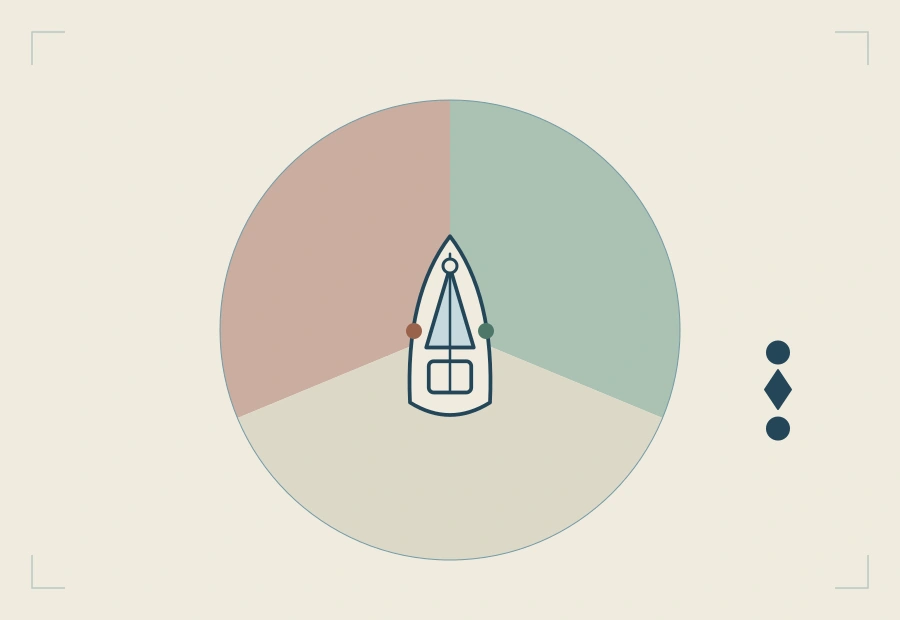
Lights and shapes tell you two things about another vessel: what she is, and which way she is pointing. This page puts all of them in one place, following Rules 21 to 30 of the collision regulations (COLREGs). It is a summary for revision: the exact wording, positions and exemptions are in the rules.
The lights themselves (Rule 21)
| Light | Colour | Arc |
|---|---|---|
| Masthead light | White | 225°: right ahead to 22.5° abaft the beam each side |
| Sidelights | Green starboard, red port | 112.5° each: right ahead to 22.5° abaft the beam |
| Sternlight | White | 135°: 67.5° either side of right astern |
| Towing light | Yellow | 135°, like the sternlight |
| All-round light | Any | 360° |
The arcs are why lights also tell you aspect: if you see her red sidelight only, you are on her port side; red and green together, she is heading straight at you.
Minimum visibility (Rule 22), in miles
| Length | Masthead | Sidelights | Stern, towing, all-round |
|---|---|---|---|
| 50 m or more | 6 | 3 | 3 |
| 12 m to under 50 m | 5 (3 if under 20 m) | 2 | 2 |
| Under 12 m | 2 | 1 | 2 |
Underway
| Vessel | By night | By day |
|---|---|---|
| Power-driven (Rule 23) | Masthead light; a second one aft and higher if 50 m or more (optional below); sidelights; sternlight | — |
| Power-driven under 12 m | May show one all-round white instead of masthead and sternlight, with sidelights | — |
| Air-cushion vessel, non-displacement mode | Power-driven lights plus an all-round flashing yellow | — |
| Sailing (Rule 25) | Sidelights and sternlight; under 20 m, may be one tricolour at the masthead; may add red over green all-round at the masthead (not with a tricolour) | — |
| Sailing and motoring | Power-driven lights | Cone, point down |
| Sailing under 7 m, or under oars | Sailing lights if practicable; otherwise a white torch or lantern, shown in time to prevent collision | — |
Towing and pushing (Rule 24)
| Vessel | By night | By day |
|---|---|---|
| Towing astern, tow 200 m or less | Two masthead lights in a vertical line, sidelights, sternlight, yellow towing light above the sternlight | — |
| Towing astern, tow over 200 m | Three masthead lights in a vertical line, and the rest as above | Diamond, on the tug and on the tow |
| Pushing ahead or towing alongside | Two masthead lights in a vertical line, sidelights, sternlight (no towing light) | — |
| Being towed | Sidelights and sternlight | Diamond if the tow is over 200 m |
Fishing (Rule 26)
| Vessel | By night | By day |
|---|---|---|
| Trawling | Green over white all-round; a masthead light aft and higher if 50 m or more; sidelights and sternlight when making way | Two cones, points together |
| Fishing, not trawling | Red over white all-round; an all-round white towards gear extending more than 150 m; sidelights and sternlight when making way | Two cones, points together; a cone point up towards gear over 150 m |
Not under command, restricted, constrained (Rules 27 and 28)
| Vessel | By night | By day |
|---|---|---|
| Not under command | Two all-round red in a vertical line; sidelights and sternlight when making way | Two balls |
| Restricted in her ability to manoeuvre | Red, white, red all-round in a vertical line; when making way, also masthead light(s), sidelights and sternlight; at anchor, also anchor lights | Ball, diamond, ball |
| Dredging or underwater operations, with an obstruction | As restricted, plus two all-round red on the obstructed side and two all-round green on the side to pass | Ball, diamond, ball; two balls on the obstructed side, two diamonds on the side to pass |
| Mine clearance | Three all-round green: one at the foremast head, one at each end of the fore yard. Keep more than 1,000 m away | Three balls in the same positions |
| Constrained by her draught | Power-driven lights, and may add three all-round red in a vertical line | Cylinder |
Pilots, anchored and aground (Rules 29 and 30)
| Vessel | By night | By day |
|---|---|---|
| Pilot vessel on duty | White over red all-round at or near the masthead; sidelights and sternlight underway; anchor lights at anchor | — |
| At anchor | All-round white forward, and a lower one aft if 50 m or more; under 50 m, one all-round white where best seen is enough | One ball forward |
| Aground | Anchor lights plus two all-round red in a vertical line | Three balls in a vertical line |
Reading them at a glance
- Two whites, one above and behind the other: a power-driven vessel of some size; the line between them shows her heading.
- Red over white: fishing. Green over white: trawling. White over red: pilot.
- Red over red: not under command. Red, white, red: restricted. Three reds: constrained by her draught.
- Yellow above a white sternlight: you are looking at a tug's stern; the tow is behind her.
Where this is in the course
The lights and shapes module is free, with no account: what a vessel shows, what she is, what you see from your own bearing, and what you hear when you cannot see her.
Lights and shapes, part 1: what she shows (free) →
Lights and shapes, part 3: from where you are (free) →
Free reading notes: navigation lights and shapes →
Free reading notes: identifying vessels by their lights →
Questions
What arcs do the masthead, side and stern lights show?
A masthead light shows white over 225 degrees, from right ahead to 22.5 degrees abaft the beam on each side. Each sidelight shows over 112.5 degrees, green to starboard and red to port. The sternlight shows white over the remaining 135 degrees astern.
What does a sailing yacht show at night?
Sidelights and a sternlight. Under 20 metres they may be combined in one tricolour lantern at the masthead. She may also show red over green all-round lights at the masthead, but not together with the tricolour.
What does red over white mean?
A vessel engaged in fishing other than trawling. Green over white is a vessel trawling. If either is making way through the water, she also shows sidelights and a sternlight.
What is the day shape for motor-sailing?
A cone, point down, shown forward where it can best be seen, by a sailing vessel that is also being propelled by machinery.
Are these the full rules?
No. This is a summary of Rules 21 to 30 of the International Regulations for Preventing Collisions at Sea and their annex. For exact wording, positions and exemptions, read the rules themselves.
Related guides
- The cocked hat and crossing bearingsChoosing marks, the angle of cut, the order you take them in, and what the cocked hat tells you.
- Planning a passage, step by stepFrom the question of whether to go, through the tide at each end and the stream, to the plan on one page.
- IALA buoyage region A, by day and by nightLateral, cardinal, isolated danger, safe water, special and emergency wreck marks: shapes, colours and lights.