The rule of twelfths, and when it fails
Offshore Theory, written by a superyacht bosun with a commercial Yachtmaster Offshore · 30 October 2026
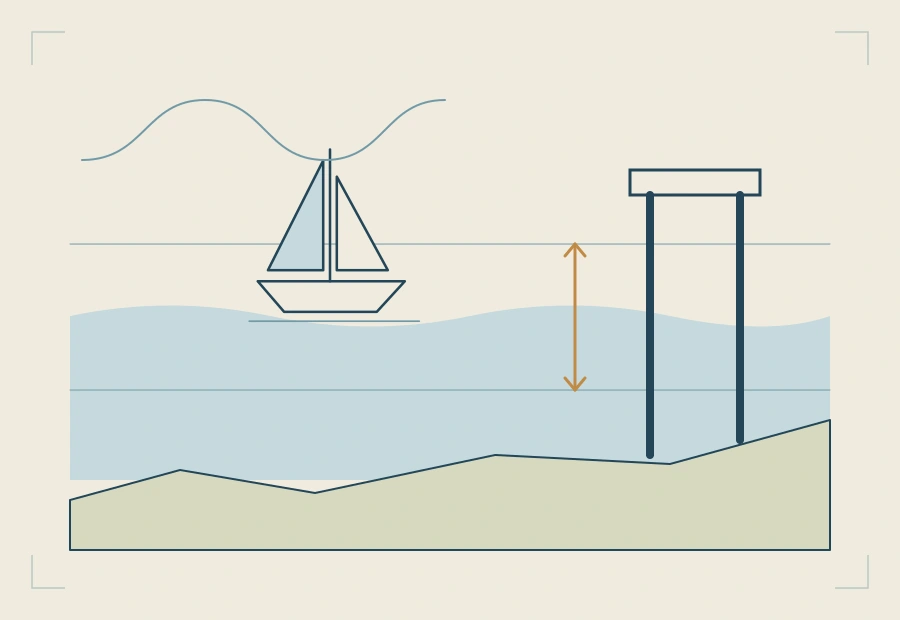
The rule of twelfths is a mental shortcut for the height of tide: over a six-hour rise or fall, the water moves one twelfth of the range in the first hour, two in the second, three in the third and fourth, two in the fifth and one in the sixth. It is quick and often close. It is also wrong at some ports, and knowing where is the useful part.
The rule, hour by hour
Take a tide that rises from low water 1.2 m at 0300 to high water 5.6 m at 0900: a range of 4.4 m over six hours. One twelfth of the range is 4.4 ÷ 12 = 0.37 m.
| Time | Twelfths in that hour | Twelfths so far | Height |
|---|---|---|---|
| 0300 | — | 0 | 1.2 m (low water) |
| 0400 | 1 | 1 | 1.2 + 0.37 = 1.6 m |
| 0500 | 2 | 3 | 1.2 + 1.10 = 2.3 m |
| 0600 | 3 | 6 | 1.2 + 2.20 = 3.4 m |
| 0700 | 3 | 9 | 1.2 + 3.30 = 4.5 m |
| 0800 | 2 | 11 | 1.2 + 4.03 = 5.2 m |
| 0900 | 1 | 12 | 5.6 m (high water) |
Between the hours, go part of the way: at 0730 you are halfway between 9 and 11 twelfths, so 10 twelfths, 1.2 + 3.67 = 4.9 m.
The falling tide works the same way from the top: 1 twelfth down in the first hour after high water, 2 in the second, and so on.
How close it is
A perfectly regular tide rises along a smooth curve, slowly at first, fastest at half tide and slowly again at the top. Measured against that curve the rule is exact at two, three and four hours, and about one sixtieth of the range out at one and at five hours: on this 4.4 m range, about 7 cm. For a regular tide that is as good as you can read most curves.
The weakness is the word "regular". The rule assumes the tide behaves like that smooth curve over six hours. Many places do not.
When it fails
- The rise is not six hours. If low water to high water takes five hours, the rule still works, but only if each "hour" is a sixth of five hours: 50 minutes. Counting real hours puts the high water in the wrong place.
- The rise and the fall are not the same length. In shallow water and in many estuaries the flood is shorter and steeper than the ebb. The rule spreads the change evenly and misses that.
- The curve is not a single smooth hump. The Solent is the classic case: a long stand around high water and, at some ports, a second high water. The almanac prints special curves for those ports because the ordinary shape does not fit them. The rule of twelfths does not fit them either.
- The question gives you a curve. Then the curve is the method. Use the rule to check that your answer is sensible, not to replace it.
A good use for it
As a cross-check, the rule is excellent. If the curve gives you 4.4 m two hours before high water and the rule gives 4.5 m, your reading is probably fine. If the curve gives you 2.9 m, look again: you may have entered the curve at the wrong side of high water, or read the neap curve on a spring day.
Where this is in the course
Standard port tide tables and the tidal curve →
Using a nautical almanac, including the Solent's special curves →
Free reading notes: the tidal curve →
Free tidal height calculator, with the curve →
Questions
What is the rule of twelfths?
A shortcut for the height of tide between low and high water. Over the six hours of a rise or fall, the tide moves 1, 2, 3, 3, 2 and 1 twelfths of the range in each hour.
Is the rule of twelfths accurate?
For a regular, symmetrical tide that rises for about six hours, it is within about one sixtieth of the range of a smooth curve: 7 cm on a 4.4 m range. Where the tide is not regular, it can be much further out.
When should I not use it?
Where the almanac gives the port a curve that is not a smooth, symmetrical rise and fall, such as the Solent with its long stand and double high water; where the rise and fall take very different times; and whenever the question gives you the curve to use.
Can I use it in the exam?
Use the method the question asks for. Where the almanac curve is given, the curve is the method; the rule of twelfths is a quick check, not a replacement.
What if the tide does not rise for six hours?
Divide the actual time from low water to high water into six equal parts and apply the twelfths to those parts. A five-hour rise has steps of 50 minutes.
Related guides
- Secondary port tidal heights, step by stepTimes and heights at a secondary port from the standard port and its differences, with a worked example.
- Springs or neaps: interpolating the tidal curveWhich curve to read on the day, and how to go part of the way between springs and neaps.
- Clearance under the keel and drying heightsSounding plus height of tide minus draught, drying heights, and the tide you need to cross a bar.