The shipping forecast and the barometer: go or no-go
Offshore Theory, written by a superyacht bosun with a commercial Yachtmaster Offshore · 30 October 2026
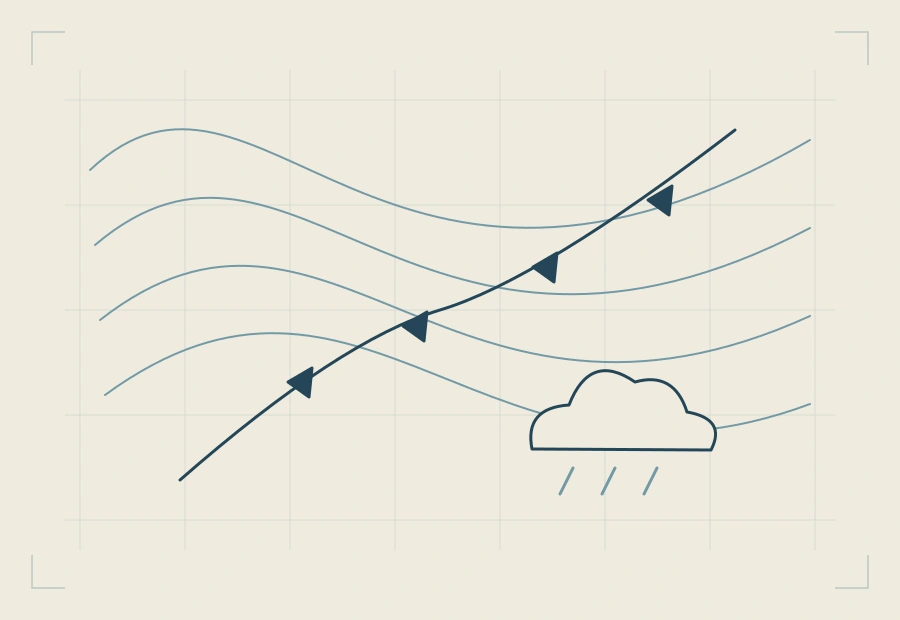
A go or no-go decision puts three things side by side: what the forecast says, what the barometer is doing, and what the boat and crew can handle. The forecast uses a small vocabulary of exact words, and each one has a defined meaning. Read them as definitions, not as impressions.
The shipping forecast
The Met Office issues it four times a day, at 2300, 0500, 1100 and 1700 UTC, for the 31 sea areas around the British Isles. It comes in a fixed order:
- Gale warnings in force: for force 8 (34 knots) or more, or gusts of 43 knots or more.
- The general synopsis: where the pressure systems are, how deep, and where they are expected to be.
- Each sea area: wind direction and force, sea state, weather, and visibility.
The exact words
| Timing | Means |
|---|---|
| Imminent | Within 6 hours of the time of issue |
| Soon | 6 to 12 hours |
| Later | More than 12 hours |
| Visibility | Means |
|---|---|
| Good | More than 5 nautical miles |
| Moderate | 2 to 5 nautical miles |
| Poor | 1,000 metres to 2 nautical miles |
| Very poor | Less than 1,000 metres |
| Sea state | Wave height | Sea state | Wave height |
|---|---|---|---|
| Smooth | 0.1 to 0.5 m | Very rough | 4 to 6 m |
| Slight | 0.5 to 1.25 m | High | 6 to 9 m |
| Moderate | 1.25 to 2.5 m | Very high | 9 to 14 m |
| Rough | 2.5 to 4 m | Phenomenal | Over 14 m |
| Beaufort force | Knots | Beaufort force | Knots |
|---|---|---|---|
| 4 | 11 to 16 | 7 | 28 to 33 |
| 5 | 17 to 21 | 8 (gale) | 34 to 40 |
| 6 | 22 to 27 | 9 (severe gale) | 41 to 47 |
The barometer: the tendency, not the reading
One reading tells you little. What matters is how much the pressure has changed in the last three hours: the barometric tendency. Write the reading in the log every hour, with the time, and take away the reading from three hours before. The forecast's own words give the scale:
| Change in 3 hours | Described as |
|---|---|
| Less than 0.1 hPa | Steady |
| 0.1 to 1.5 hPa | Rising or falling slowly |
| 1.6 to 3.5 hPa | Rising or falling |
| 3.6 to 6.0 hPa | Rising or falling quickly |
| More than 6.0 hPa | Rising or falling very rapidly |
Two cautions. In settled weather the pressure rises and falls a little through the day on its own, which can look like a tendency. And in the northern hemisphere, with your back to the wind, low pressure is on your left (Buys Ballot's law): a falling barometer with the wind backing usually means a depression approaching from the west.
A worked decision
A day sail of about seven hours, leaving at 1000. The crew are comfortable up to force 5. The 0500 forecast for the area reads: "Southwest 4 or 5, increasing 6 later. Slight or moderate. Showers. Good, occasionally moderate."
- The forecast: force 4 or 5 now, 6 more than 12 hours after issue, so after 1700 on paper. The passage ends around 1700. On the forecast alone, it is tight but inside the crew's limit.
- The barometer: 1012 hPa at 0600, 1010 at 0700, 1008 at 0800, 1007 at 0900. That is a fall of 5 hPa in three hours: falling quickly.
- Put together: the pressure is falling faster than a slow increase "later" suggests. The force 6 may arrive early, in the second half of the passage, with the crew at their limit and the boat furthest from shelter.
- The decision: no-go for the seven-hour passage. A shorter sail with a harbour close downwind, back well before midday, or a day in port. Check the 1100 forecast and the barometer before changing your mind.
The figures are an example made up for this guide. The method is the point: the forecast's words, the barometer's tendency, and the crew's limit, compared one against the other.
Where this is in the course
Marine forecasts: where to get them and how to read them →
The barometer and the go/no-go decision →
Pressure and wind: isobars, Buys Ballot and Beaufort →
Questions
How often is the shipping forecast issued?
The Met Office issues it four times a day, at 2300, 0500, 1100 and 1700 UTC, each covering the 24 hours from 0000, 0600, 1200 and 1800 UTC.
What do imminent, soon and later mean?
In Met Office forecasts, imminent means within 6 hours of the time of issue, soon means 6 to 12 hours, and later means more than 12 hours.
When is a gale warning issued?
For winds of force 8 (34 knots) or more, or gusts reaching 43 knots or more. They are issued as required. Gale warnings remain in force until amended or cancelled, and are reissued if the gale persists beyond 24 hours.
What does falling quickly mean on a barometer?
In the forecast's words, a fall of 3.6 to 6.0 hPa in three hours. Falling slowly is 0.1 to 1.5, falling is 1.6 to 3.5, and falling very rapidly is more than 6.0.
Should the barometer override the forecast?
No: it adds to it. The forecast tells you what is expected; the barometer and the sky tell you whether it is happening as forecast, sooner, or harder. A barometer falling faster than the forecast suggests is a reason to be more cautious, not less.
Related guides
- Planning a passage, step by stepFrom the question of whether to go, through the tide at each end and the stream, to the plan on one page.
- Navigation lights and shapes: a quick referenceEvery vessel's lights and day shapes in one place, with their arcs and what they tell you.
- IALA buoyage region A, by day and by nightLateral, cardinal, isolated danger, safe water, special and emergency wreck marks: shapes, colours and lights.